AI Chatbot Free No Sign Up

AI Chatbot Free No Sign Up — independent reviews, comparisons, pricing and step-by-step guides on Aizhi.

  • FloodAlerts

    FloodAlerts

    FloodAlerts is a software application, developed by software specialists Shoothill, which takes real-time flooding information, and displays the data on an interactive Bing map, updating and warning its users when they, their premises or the routes they need to travel could be at risk of flooding. == History == FloodAlerts was launched in 2012, originally as the world's first Facebook flood warning app. == Operation == FloodAlerts is made available free of charge to individuals. Users are able to set up their own monitored locations and receive alerts via the application or their Facebook wall if the locations they are monitoring are at imminent risk of flooding. Hosted in the Cloud, using the Microsoft Windows Azure platform, the FloodAlerts application processes the data received from the Environment Agency, automatically creates the required map tiles, pins and alerts and displays them on an interactive Bing map, updating the content every 15 minutes. Users are able to see the latest information on the map without having to refresh their browser. FloodAlerts can also be provided as a customised risk management solution to businesses that require infrastructure or asset safety monitoring in areas where water levels are rising or receding. == Awards and recognition == FloodAlerts has received The Guardian and Virgin Media Business's 2012 Innovation Nation Awards and was shortlisted as a finalist for a further two national awards: the UK IT Industry Awards for Innovation and Entrepreneurship and The Institution of Engineering and Technology Innovation Awards for Information Technology. == In the press == The FloodAlerts application was reviewed on the BBC website. It was also reviewed on BBC Click.

    Read more →
  • Dynamic Graphics Project

    Dynamic Graphics Project

    The Dynamic Graphics Project (commonly referred to as DGP) is an interdisciplinary research laboratory at the University of Toronto devoted to projects involving computer graphics, computer vision, human computer interaction, and visualization. The lab began as the computer graphics research group of Department of Computer Science Professor Leslie Mezei in 1967. Mezei invited Bill Buxton, a pioneer of human–computer interaction (HCI) to join. In 1972, Ronald Baecker, another HCI pioneer joined, establishing DGP as the first Canadian university group focused on computer graphics and human-computer interaction. According to csrankings.org, the DGP is the top research institution in the world for the combined subfields of computer graphics, HCI, and visualization. Since then, DGP has hosted many well known faculty and students in computer graphics, computer vision and HCI (e.g., Alain Fournier, Bill Reeves, Jos Stam, Demetri Terzopoulos, Marilyn Tremaine). DGP also occasionally hosts artists in residence (e.g., Oscar-winner Chris Landreth). Many past and current researchers at Autodesk (and before that Alias Wavefront) graduated after working at DGP. DGP is located in the St. George campus of University of Toronto in the Bahen Centre for Information Technology. DGP researchers regularly publish at ACM SIGGRAPH, ACM SIGCHI and ICCV. DGP hosts the Toronto User Experience (TUX) Speaker Series and the Sanders Series Lectures. == Notable alumni == Bill Buxton (MS 1978) James McCrae (PhD 2013) Dimitris Metaxas (PhD 1992) Bill Reeves (MS 1976, Ph.D. 1980) Jos Stam (MS 1991, Ph.D. 1995)

    Read more →
  • Google Books Ngram Viewer

    Google Books Ngram Viewer

    The Google Books Ngram Viewer is an online search engine that charts the frequencies of any set of search strings using a yearly count of n-grams found in printed sources published between 1500 and 2022 in Google's text corpora in English, Chinese (simplified), French, German, Hebrew, Italian, Russian, or Spanish. There are also some specialized English corpora, such as American English, British English, and English Fiction. The program can search for a word or a phrase. The n-grams are matched with the text within the selected corpus, and if found in 40 or more books, are then displayed as a graph. The program supports searches for parts of speech and wildcards. It is routinely used in research. == History == The Ngram Viewer was created by Google software engineers Will Brockman and Jon Orwant , who teamed up with Harvard researchers Jean-Baptiste Michel and Erez Lieberman Aiden. The service was released on December 16, 2010. Before the release, it was difficult to quantify the rate of linguistic change because of the absence of a database that was designed for this purpose, said Steven Pinker, a well-known linguist who was one of the co-authors of the Science paper published on the same day. The Google Books Ngram Viewer was developed in the hope of opening a new window to quantitative research in the humanities field, and the database contained 500 billion words from 5.2 million books publicly available from the very beginning. The intended audience was scholarly, but the Google Books Ngram Viewer made it possible for anyone with a computer to see a graph that represents the diachronic change of the use of words and phrases with ease. Lieberman said in response to The New York Times that the developers aimed to provide even children with the ability to browse cultural trends throughout history. In the Science paper, Lieberman and his collaborators called the method of high-volume data analysis in digitized texts "culturomics". == Usage == Commas delimit user-entered search terms, where each comma-separated term is searched in the database as an n-gram (for example, "nursery school" is a 2-gram or bigram). The Ngram Viewer then returns a plotted line chart. Due to limitations on the size of the Ngram database, only matches found in at least 40 books are indexed. == Limitations == The data sets of the Ngram Viewer have been criticized for their reliance upon inaccurate optical character recognition (OCR) and for including large numbers of incorrectly dated and categorized texts. Because of these errors, and because they are uncontrolled for bias (such as the increasing amount of scientific literature, which causes other terms to appear to decline in popularity), care must be taken in using the corpora to study language or test theories. Furthermore, the data sets may not reflect general linguistic or cultural change and can only hint at such an effect because they do not involve any metadata like date published, author, length, or genre, to avoid any potential copyright infringements. Systemic errors like the confusion of s and f in pre-19th century texts (due to the use of ſ, the long s, which is similar in appearance to f) can cause systemic bias. Although the Google Books team claims that the results are reliable from 1800 onwards, poor OCR and insufficient data mean that frequencies given for languages such as Chinese may only be accurate from 1970 onward, with earlier parts of the corpus showing no results at all for common terms, and data for some years containing more than 50% noise. Guidelines for doing research with data from Google Ngram have been proposed that try to address some of the issues discussed above.

    Read more →
  • Quantum natural language processing

    Quantum natural language processing

    Quantum natural language processing (QNLP) is the application of quantum computing to natural language processing (NLP). It computes word embeddings as parameterised quantum circuits that can solve NLP tasks faster than any classical computer. It is inspired by categorical quantum mechanics and the DisCoCat framework, making use of string diagrams to translate from grammatical structure to quantum processes. == Theory == The first quantum algorithm for natural language processing used the DisCoCat framework and Grover's algorithm to show a quadratic quantum speedup for a text classification task. It was later shown that quantum language processing is BQP-Complete, i.e. quantum language models are more expressive than their classical counterpart, unless quantum mechanics can be efficiently simulated by classical computers. These two theoretical results assume fault-tolerant quantum computation and a QRAM, i.e. an efficient way to load classical data on a quantum computer. Thus, they are not applicable to the noisy intermediate-scale quantum (NISQ) computers available today. == Experiments == The algorithm of Zeng and Coecke was adapted to the constraints of NISQ computers and implemented on IBM quantum computers to solve binary classification tasks. Instead of loading classical word vectors onto a quantum memory, the word vectors are computed directly as the parameters of quantum circuits. These parameters are optimised using methods from quantum machine learning to solve data-driven tasks such as question answering, machine translation and even algorithmic music composition.

    Read more →
  • Synonym (database)

    Synonym (database)

    In databases, a synonym is an alias or alternate name for a table, view, sequence, or other schema object. They are used mainly to make it intuitive for users to access database objects owned by other users. They also hide the underlying object's identity and make it harder for a malicious program or user to target the underlying object (security through obscurity). Because a synonym is just an alternate name for an object, it requires no storage other than its definition. When an application uses a synonym, the DBMS forwards the request to the synonym's underlying base object. By coding your programs to use synonyms instead of database object names, you insulate yourself from any changes in the name, ownership, or object locations, at the cost of adding another layer that also needs to be maintained. Users can also have different needs, for example some may wish to use a shorter name to refer to database objects they often query, which can be done with aliases without having to rename the underlying object and alter the code referring to it. Synonyms are very powerful from the point of view of allowing users access to objects that do not lie within their schema. All synonyms have to be created explicitly with the CREATE SYNONYM command and the underlying objects can be located in the same database or in other databases that are connected by database links There are two major uses of synonyms: Object invisibility: Synonyms can be created to keep the original object hidden from the user. Location invisibility: Synonyms can be created as aliases for tables and other objects that are not part of the local database. When a table or a procedure is created, it is created in a particular schema, and other users can access it only by using that schema's name as a prefix to the object's name. The way around for this is for the schema owner creates a synonym with the same name as the table name. == Public synonyms == Public synonyms are owned by special schema in the Oracle Database called PUBLIC. As mentioned earlier, public synonyms can be referenced by all users in the database. Public synonyms are usually created by the application owner for the tables and other objects such as procedures and packages so the users of the application can see the objects The following code shows how to create a public synonym for the employee table: Now any user can see the table by just typing the original table name. If you wish, you could provide a different table name for that table in the CREATE SYNONYM statement. Remember that the DBA must create public synonyms. Just because you can see a table through public (or private) synonym doesn’t mean that you can also perform SELECT, INSERT, UPDATE or DELETE operations on the table. To be able to perform those operations, a user needs specific privileges for the underlying object, either directly or through roles from the application owner. == Private synonyms == A private synonym is a synonym within a database schema that a developer typically uses to mask the true name of a table, view stored procedure, or other database object in an application schema. Private synonyms, unlike public synonyms, can be referenced only by the schema that owns the table or object. You may want to create private synonyms when you want to refer to the same table by different contexts. Private synonym overrides public synonym definitions. You create private synonyms the same way you create public synonyms, but you omit the PUBLIC keyword in the CREATE statement. The following example shows how to create a private synonym called addresses for the locations table. Note that once you create the private synonym, you can refer to the synonym exactly as you would the original table name. == Drop a synonym == Synonyms, both private and public, are dropped in the same manner by using the DROP SYNONYM command, but there is one important difference. If you are dropping a public synonym; you need to add the keyword PUBLIC after the keyword DROP. The ALL_SYNONYMS (or DBA_SYNONYMS) view provides information on all synonyms in your database.

    Read more →
  • Cyclodisparity

    Cyclodisparity

    In vision science, cyclodisparity is the difference in the rotation angle of an object or scene viewed by the left and right eyes. Cyclodisparity can result from the eyes' torsional rotation (cyclorotation) or can be created artificially by presenting to the eyes two images that need to be rotated relative to each other for binocular fusion to take place. == Human and animal vision == The eyes and visual system can compensate for cyclodisparity up to a certain point; if the cyclodisparity is larger than a threshold, the images cannot be fused, resulting stereoblindness, and in double vision in subjects who otherwise have full stereo vision. When a human subject is presented with images that have artificial cyclodisparity, cyclovergence is evoked, that is, a motor response of the eye muscles that rotates the two eyes in opposite directions, thereby reducing cyclodisparity. Visually-induced cyclovergence of up to 8 degrees has been observed in normal subjects. Furthermore, up to about 8 degrees can usually be compensated by purely sensory means, that is, without physical eye rotation. This means that the normal human observer can achieve binocular image fusion in presence of cyclodisparity of up to approximately 16 degrees. Cyclodisparity due to images having been rotated inward can be compensated better when the gaze is directed downwards, and cyclodisparity due to an outward rotation can be compensated better when the gaze is directed upwards. A proposed explanation for this phenomenon is that the motor system is coordinated in such a way that the eyes perform a torsional movement to reduce the size of the search zones and thus the computational load required for solving the correspondence problem. The resulting cyclovergence at near gaze is smaller than the cyclovergence predicted by Listing's law. == Video processing and computer vision == Active camera torsion can be used in machine and computer vision for several purposes. For instance, camera torsion can be used to make improved use of the search range over which matching detectors or stereo matching algorithms operate, or to make a 3D slanted surface appear frontoparallel for further stereo processing. For image compression purposes, images with cyclodisparity are advantageously encoded using global motion compensation using a rotational motion model.

    Read more →
  • Immuni

    Immuni

    Immuni was an open-source COVID-19 contact tracing app used for digital contact tracing in Italy, dismissed on 31 December 2022, after a long and debated criticism for having been a failure due to the lack of trust placed by citizens. Immuni COVID-19 contact-tracing app had in fact been downloaded only by 12% of Italians between 14 and 75 years old (the government had previously stated that, in order for the app to work properly, it should have been downloaded by at least 60% of Italians). It makes use of the Apple/Google Exposure Notification system. == Development == It was developed by Bending Spoons and released by the Italian Ministry of Health on 1 June 2020. After a testing phase in 4 Italian regions (Abruzzo, Apulia, Liguria, Marche), the app started being active in the whole country on 15 June 2020. The app was initially released on App Store and Google Play, and since 1 February 2021 it is available on the Huawei AppGallery as well. === Source code === The source code was published on GitHub on the 25 May. The app only works in Italy, but compatibility with other European contact tracing apps was a goal. Since 19 October 2020 the app supports key-exchanges with the EU Interoperability Gateway and is therefore able to communicate with contact tracing apps of other EU countries. == Shutdown == As of 16 December 2020, the app was downloaded more than 10 million times, a number which increased to 21.882.502 downloads the day before the app's shutdown. On 27 December 2022 the Italian Ministry of Health announced that the app and its infrastructures will be dismissed on the 31 December of the same year.

    Read more →
  • Application permissions

    Application permissions

    Permissions are a means of controlling and regulating access to specific system- and device-level functions by software. Typically, types of permissions cover functions that may have privacy implications, such as the ability to access a device's hardware features (including the camera and microphone), and personal data (such as storage devices, contacts lists, and the user's present geographical location). Permissions are typically declared in an application's manifest, and certain permissions must be specifically granted at runtime by the user—who may revoke the permission at any time. Permission systems are common on mobile operating systems, where permissions needed by specific apps must be disclosed via the platform's app store. == Mobile devices == On mobile operating systems for smartphones and tablets, typical types of permissions regulate: Access to storage and personal information, such as contacts, calendar appointments, etc. Location tracking. Access to the device's internal camera and/or microphone. Access to biometric sensors, including fingerprint readers and other health sensors.. Internet access. Access to communications interfaces (including their hardware identifiers and signal strength where applicable, and requests to enable them), such as Bluetooth, Wi-Fi, NFC, and others. Making and receiving phone calls. Sending and reading text messages The ability to perform in-app purchases. The ability to "overlay" themselves within other apps. Installing, deleting and otherwise managing applications. Authentication tokens (e.g., OAuth tokens) from web services stored in system storage for sharing between apps. Prior to Android 6.0 "Marshmallow", permissions were automatically granted to apps at runtime, and they were presented upon installation in Google Play Store. Since Marshmallow, certain permissions now require the app to request permission at runtime by the user. These permissions may also be revoked at any time via Android's settings menu. Usage of permissions on Android are sometimes abused by app developers to gather personal information and deliver advertising; in particular, apps for using a phone's camera flash as a flashlight (which have grown largely redundant due to the integration of such functionality at the system level on later versions of Android) have been known to require a large array of unnecessary permissions beyond what is actually needed for the stated functionality. iOS imposes a similar requirement for permissions to be granted at runtime, with particular controls offered for enabling of Bluetooth, Wi-Fi, and location tracking. == WebPermissions == WebPermissions is a permission system for web browsers. When a web application needs some data behind permission, it must request it first. When it does it, a user sees a window asking him to make a choice. The choice is remembered, but can be cleared lately. Currently the following resources are controlled: geolocation desktop notifications service workers sensors audio capturing devices, like sound cards, and their model names and characteristics video capturing devices, like cameras, and their identifiers and characteristics == Analysis == The permission-based access control model assigns access privileges for certain data objects to application. This is a derivative of the discretionary access control model. The access permissions are usually granted in the context of a specific user on a specific device. Permissions are granted permanently with few automatic restrictions. In some cases permissions are implemented in 'all-or-nothing' approach: a user either has to grant all the required permissions to access the application or the user can not access the application. There is still a lack of transparency when the permission is used by a program or application to access the data protected by the permission access control mechanism. Even if a user can revoke a permission, the app can blackmail a user by refusing to operate, for example by just crashing or asking user to grant the permission again in order to access the application. The permission mechanism has been widely criticized by researchers for several reasons, including; Intransparency of personal data extraction and surveillance, including the creation of a false sense of security; End-user fatigue of micro-managing access permissions leading to a fatalistic acceptance of surveillance and intransparency; Massive data extraction and personal surveillance carried out once the permissions are granted. Some apps, such as XPrivacy and Mockdroid spoof data in order to act as a measure for privacy. Further transparency methods include longitudinal behavioural profiling and multiple-source privacy analysis of app data access.

    Read more →
  • Representation collapse

    Representation collapse

    Representation collapse is a phenomenon in machine learning and representation learning where a model maps different inputs to the same or very similar embeddings, which means it loses important information about how the data is spread out. It is frequently encountered in self-supervised learning, especially within contrastive and non-contrastive frameworks, when training objectives or model architectures do not maintain variance across representations. Collapse results in degenerate solutions characterized by uninformative learned features, significantly impairing downstream task performance. Various techniques have been proposed to mitigate representation collapse, including the use of negative samples, architectural asymmetry, stop-gradient operations, variance regularization, and redundancy reduction objectives, as seen in methods such as SimCLR, BYOL, and VICReg. Comprehending and averting representation collapse is regarded as a fundamental challenge in the advancement of stable and efficient self-supervised learning systems.

    Read more →
  • Chai AI

    Chai AI

    Chai AI (also known as Chai Research) is an American artificial intelligence (AI) company that operates a chatbot platform where users can create, share, and interact with character-based chatbots powered by large language models (LLMs). The company is headquartered in Palo Alto, California. == History == Chai was founded in 2021 by William Beauchamp, a former quantitative trader educated at Cambridge, who began developing the initial prototype in 2020 in Cambridge, England. The company launched in 2021 and relocated to Palo Alto in 2022. In June 2023, Chai raised US$2 million in a pre-seed funding round. In September 2023, GPU cloud provider CoreWeave invested in the company at a valuation of US$450 million. In January 2024, Chai Research reported a $450 million valuation following an investment from cloud computing provider CoreWeave. In July 2024, authorities in Belgium launched an investigation into the company following reports of a man dying by suicide following extensive chats on the Chai app. == Reception == In 2025, Chai Research announced that their app had over 10 million downloads and 1 million daily active users. In 2022, Canadian writer Sheila Heti published her conversations with various chatbots in The Paris Review, including Chai AI chatbots, and later used Chai AI chatbots in the development of a novel. Heti said that she had found that Chai's default chatbot, Eliza, "had turned out to be like most of the other bots on the site—primarily interested in sex". In January 2026, CHAI introduced country-based blocks on its free, ad-supported tier, initially providing the community with little information and inaccurate lists of the affected countries. Users in "Low tier" regions are required to subscribe to use the app in any capacity, while "High tier" regions will retain free ad-supported access. In response to backlash, the company announced a "Basic" tier with unlimited messages and ads, intended to cover electricity and infrastructure costs. In February 2026, CHAI was criticized for the unannounced implementation of restrictive "token limits" that abruptly blocked messages and froze conversations for both free and paid subscribers. Users generating long responses or utilizing roleplay features found their quotas exhausted within minutes, resulting in lockouts lasting anywhere from a few hours to a week. == Technology == Chai allows users to create characters and interact with chatbot versions of those characters. These chatbots use the open-source large language model (LLM) GPT-J originally developed by EleutherAI. Chai AI chatbots can be shared on the platform for other users to interact with.

    Read more →
  • Neighborhood operation

    Neighborhood operation

    In computer vision and image processing a neighborhood operation is a commonly used class of computations on image data which implies that it is processed according to the following pseudo code: Visit each point p in the image data and do { N = a neighborhood or region of the image data around the point p result(p) = f(N) } This general procedure can be applied to image data of arbitrary dimensionality. Also, the image data on which the operation is applied does not have to be defined in terms of intensity or color, it can be any type of information which is organized as a function of spatial (and possibly temporal) variables in p. The result of applying a neighborhood operation on an image is again something which can be interpreted as an image, it has the same dimension as the original data. The value at each image point, however, does not have to be directly related to intensity or color. Instead it is an element in the range of the function f, which can be of arbitrary type. Normally the neighborhood N is of fixed size and is a square (or a cube, depending on the dimensionality of the image data) centered on the point p. Also the function f is fixed, but may in some cases have parameters which can vary with p, see below. In the simplest case, the neighborhood N may be only a single point. This type of operation is often referred to as a point-wise operation. == Examples == The most common examples of a neighborhood operation use a fixed function f which in addition is linear, that is, the computation consists of a linear shift invariant operation. In this case, the neighborhood operation corresponds to the convolution operation. A typical example is convolution with a low-pass filter, where the result can be interpreted in terms of local averages of the image data around each image point. Other examples are computation of local derivatives of the image data. It is also rather common to use a fixed but non-linear function f. This includes median filtering, and computation of local variances. The Nagao-Matsuyama filter is an example of a complex local neighbourhood operation that uses variance as an indicator of the uniformity within a pixel group. The result is similar to a convolution with a low-pass filter with the added effect of preserving sharp edges. There is also a class of neighborhood operations in which the function f has additional parameters which can vary with p: Visit each point p in the image data and do { N = a neighborhood or region of the image data around the point p result(p) = f(N, parameters(p)) } This implies that the result is not shift invariant. Examples are adaptive Wiener filters. == Implementation aspects == The pseudo code given above suggests that a neighborhood operation is implemented in terms of an outer loop over all image points. However, since the results are independent, the image points can be visited in arbitrary order, or can even be processed in parallel. Furthermore, in the case of linear shift-invariant operations, the computation of f at each point implies a summation of products between the image data and the filter coefficients. The implementation of this neighborhood operation can then be made by having the summation loop outside the loop over all image points. An important issue related to neighborhood operation is how to deal with the fact that the neighborhood N becomes more or less undefined for points p close to the edge or border of the image data. Several strategies have been proposed: Compute result only for points p for which the corresponding neighborhood is well-defined. This implies that the output image will be somewhat smaller than the input image. Zero padding: Extend the input image sufficiently by adding extra points outside the original image which are set to zero. The loops over the image points described above visit only the original image points. Border extension: Extend the input image sufficiently by adding extra points outside the original image which are set to the image value at the closest image point. The loops over the image points described above visit only the original image points. Mirror extension: Extend the image sufficiently much by mirroring the image at the image boundaries. This method is less sensitive to local variations at the image boundary than border extension. Wrapping: The image is tiled, so that going off one edge wraps around to the opposite side of the image. This method assumes that the image is largely homogeneous, for example a stochastic image texture without large textons.

    Read more →
  • PatchMatch

    PatchMatch

    PatchMatch is an algorithm used to quickly find correspondences (or matches) between small square regions (or patches) of an image. It has various applications in image editing, such as reshuffling or removing objects from images or altering their aspect ratios without cropping or noticeably stretching them. PatchMatch was first presented in a 2011 paper by researchers at Princeton University. == Algorithm == The goal of the algorithm is to find the patch correspondence by defining a nearest-neighbor field (NNF) as a function f : R 2 → R 2 {\displaystyle f:\mathbb {R} ^{2}\to \mathbb {R} ^{2}} of offsets, which is over all possible matches of patch (location of patch centers) in image A, for some distance function of two patches D {\displaystyle D} . So, for a given patch coordinate a {\displaystyle a} in image A {\displaystyle A} and its corresponding nearest neighbor b {\displaystyle b} in image B {\displaystyle B} , f ( a ) {\displaystyle f(a)} is simply b − a {\displaystyle b-a} . However, if we search for every point in image B {\displaystyle B} , the work will be too hard to complete. So the following algorithm is done in a randomized approach in order to accelerate the calculation speed. The algorithm has three main components. Initially, the nearest-neighbor field is filled with either random offsets or some prior information. Next, an iterative update process is applied to the NNF, in which good patch offsets are propagated to adjacent pixels, followed by random search in the neighborhood of the best offset found so far. Independent of these three components, the algorithm also uses a coarse-to-fine approach by building an image pyramid to obtain the better result. === Initialization === When initializing with random offsets, we use independent uniform samples across the full range of image B {\displaystyle B} . This algorithm avoids using an initial guess from the previous level of the pyramid because in this way the algorithm can avoid being trapped in local minima. === Iteration === After initialization, the algorithm attempted to perform iterative process of improving the N N F {\displaystyle NNF} . The iterations examine the offsets in scan order (from left to right, top to bottom), and each undergoes propagation followed by random search. === Propagation === We attempt to improve f ( x , y ) {\displaystyle f(x,y)} using the known offsets of f ( x − 1 , y ) {\displaystyle f(x-1,y)} and f ( x , y − 1 ) {\displaystyle f(x,y-1)} , assuming that the patch offsets are likely to be the same. That is, the algorithm will take new value for f ( x , y ) {\displaystyle f(x,y)} to be arg ⁡ min ( x , y ) D ( f ( x , y ) ) , D ( f ( x − 1 , y ) ) , D ( f ( x , y − 1 ) ) {\displaystyle \arg \min \limits _{(x,y)}{D(f(x,y)),D(f(x-1,y)),D(f(x,y-1))}} . So if f ( x , y ) {\displaystyle f(x,y)} has a correct mapping and is in a coherent region R {\displaystyle R} , then all of R {\displaystyle R} below and to the right of f ( x , y ) {\displaystyle f(x,y)} will be filled with the correct mapping. Alternatively, on even iterations, the algorithm search for different direction, fill the new value to be arg ⁡ min ( x , y ) { D ( f ( x , y ) ) , D ( f ( x + 1 , y ) ) , D ( f ( x , y + 1 ) ) } {\displaystyle \arg \min \limits _{(x,y)}\{D(f(x,y)),D(f(x+1,y)),D(f(x,y+1))\}} . === Random search === Let v 0 = f ( x , y ) {\displaystyle v_{0}=f(x,y)} , we attempt to improve f ( x , y ) {\displaystyle f(x,y)} by testing a sequence of candidate offsets at an exponentially decreasing distance from v 0 {\displaystyle v_{0}} u i = v 0 + w α i R i {\displaystyle u_{i}=v_{0}+w\alpha ^{i}R_{i}} where R i {\displaystyle R_{i}} is a uniform random in [ − 1 , 1 ] × [ − 1 , 1 ] {\displaystyle [-1,1]\times [-1,1]} , w {\displaystyle w} is a large window search radius which will be set to maximum picture size, and α {\displaystyle \alpha } is a fixed ratio often assigned as 1/2. This part of the algorithm allows the f ( x , y ) {\displaystyle f(x,y)} to jump out of local minimum through random process. === Halting criterion === The often used halting criterion is set the iteration times to be about 4~5. Even with low iteration, the algorithm works well.

    Read more →
  • Intelligent control

    Intelligent control

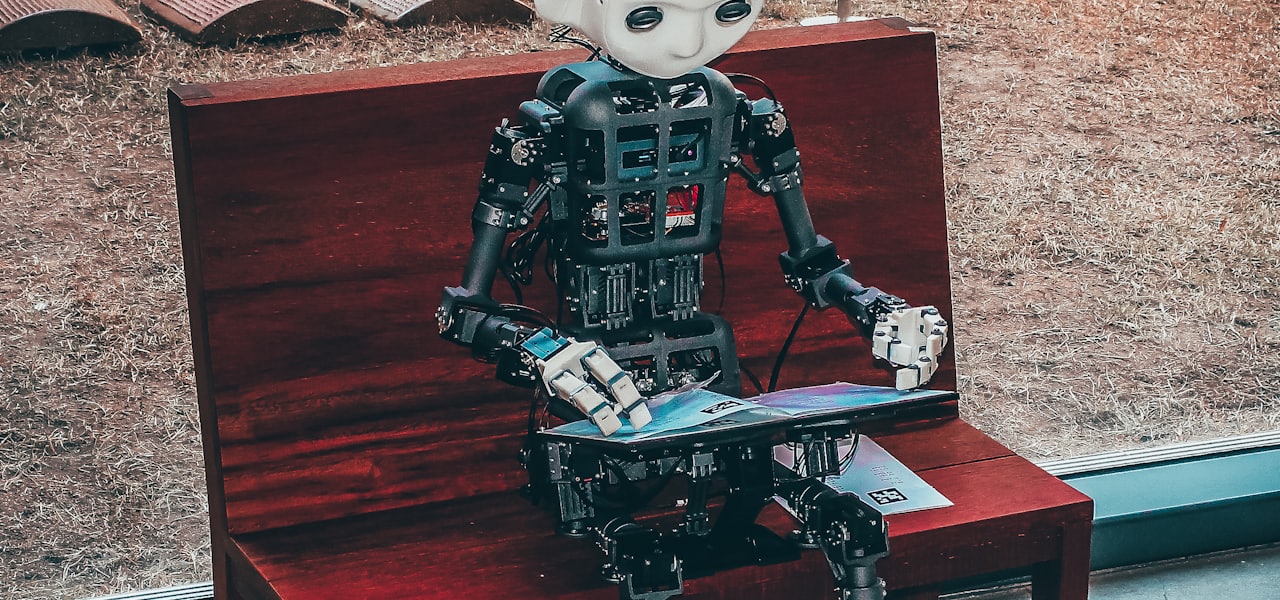
    Intelligent control is a class of control techniques that use various artificial intelligence computing approaches like neural networks, Bayesian probability, fuzzy logic, machine learning, reinforcement learning, evolutionary computation and genetic algorithms. == Overview == Intelligent control can be divided into the following major sub-domains: Neural network control Machine learning control Reinforcement learning Bayesian control Fuzzy control Neuro-fuzzy control Expert Systems Genetic control New control techniques are created continuously as new models of intelligent behavior are created and computational methods developed to support them. === Neural network controller === Neural networks have been used to solve problems in almost all spheres of science and technology. Neural network control basically involves two steps: System identification Control It has been shown that a feedforward network with nonlinear, continuous and differentiable activation functions have universal approximation capability. Recurrent networks have also been used for system identification. Given, a set of input-output data pairs, system identification aims to form a mapping among these data pairs. Such a network is supposed to capture the dynamics of a system. For the control part, deep reinforcement learning has shown its ability to control complex systems. === Bayesian controllers === Bayesian probability has produced a number of algorithms that are in common use in many advanced control systems, serving as state space estimators of some variables that are used in the controller. The Kalman filter and the Particle filter are two examples of popular Bayesian control components. The Bayesian approach to controller design often requires an important effort in deriving the so-called system model and measurement model, which are the mathematical relationships linking the state variables to the sensor measurements available in the controlled system. In this respect, it is very closely linked to the system-theoretic approach to control design.

    Read more →
  • Photometric stereo

    Photometric stereo

    Photometric stereo is a technique in computer vision for estimating the surface normals of objects by observing that object under different lighting conditions (photometry). It is based on the fact that the amount of light reflected by a surface is dependent on the orientation of the surface in relation to the light source and the observer. By measuring the amount of light reflected into a camera, the space of possible surface orientations is limited. Given enough light sources from different angles, the surface orientation may be constrained to a single orientation or even overconstrained. The technique was originally introduced by Woodham in 1980. The special case where the data is a single image is known as shape from shading, and was analyzed by B. K. P. Horn in 1989. Photometric stereo has since been generalized to many other situations, including extended light sources and non-Lambertian surface finishes. Current research aims to make the method work in the presence of projected shadows, highlights, and non-uniform lighting. Photometric stereo is widely used in various fields, including archaeology, cultural heritage conservation, and quality control. It is now integrated into widely used open-source software, such as Meshroom. == Basic method == Under Woodham's original assumptions — Lambertian reflectance, known point-like distant light sources, and uniform albedo — the problem can be solved by inverting the linear equation I = L ⋅ n {\displaystyle I=L\cdot n} , where I {\displaystyle I} is a (known) vector of m {\displaystyle m} observed intensities, n {\displaystyle n} is the (unknown) surface normal, and L {\displaystyle L} is a (known) 3 × m {\displaystyle 3\times m} matrix of normalized light directions. This model can easily be extended to surfaces with non-uniform albedo, while keeping the problem linear. Taking an albedo reflectivity of k {\displaystyle k} , the formula for the reflected light intensity becomes I = k ( L ⋅ n ) . {\displaystyle I=k(L\cdot n).} If L {\displaystyle L} is square (there are exactly 3 lights) and non-singular, it can be inverted, giving L − 1 I = k n . {\displaystyle L^{-1}I=kn.} Since the normal vector is known to have length 1, k {\displaystyle k} must be the length of the vector k n {\displaystyle kn} , and n {\displaystyle n} is the normalised direction of that vector. If L {\displaystyle L} is not square (there are more than 3 lights), a generalisation of the inverse can be obtained using the Moore–Penrose pseudoinverse, by simply multiplying both sides with L T {\displaystyle L^{T}} , giving L T I = L T k ( L ⋅ n ) , {\displaystyle L^{T}I=L^{T}k(L\cdot n),} ( L T L ) − 1 L T I = k n , {\displaystyle (L^{T}L)^{-1}L^{T}I=kn,} after which the normal vector and albedo can be solved as described above. == Non-Lambertian surfaces == The classical photometric stereo problem concerns itself only with Lambertian surfaces, with perfectly diffuse reflection. This is unrealistic for many types of materials, especially metals, glass and smooth plastics, and will lead to aberrations in the resulting normal vectors. Many methods have been developed to lift this assumption. In this section, a few of these are listed. === Specular reflections === Historically, in computer graphics, the commonly used model to render surfaces started with Lambertian surfaces and progressed first to include simple specular reflections. Computer vision followed a similar course with photometric stereo. Specular reflections were among the first deviations from the Lambertian model. These are a few adaptations that have been developed. Many techniques ultimately rely on modelling the reflectance function of the surface, that is, how much light is reflected in each direction. This reflectance function has to be invertible. The reflected light intensities towards the camera is measured, and the inverse reflectance function is fit onto the measured intensities, resulting in a unique solution for the normal vector. === General BRDFs and beyond === According to the Bidirectional reflectance distribution function (BRDF) model, a surface may distribute the amount of light it receives in any outward direction. This is the most general known model for opaque surfaces. Some techniques have been developed to model (almost) general BRDFs. In practice, all of these require many light sources to obtain reliable data. These are methods in which surfaces with general BRDFs can be measured. Determine the explicit BRDF prior to scanning. To do this, a different surface is required that has the same or a very similar BRDF, of which the actual geometry (or at least the normal vectors for many points on the surface) is already known. The lights are then individually shone upon the known surface, and the amount of reflection into the camera is measured. Using this information, a look-up table can be created that maps reflected intensities for each light source to a list of possible normal vectors. This puts constraints on the possible normal vectors the surface may have, and reduces the photometric stereo problem to an interpolation between measurements. Typical known surfaces to calibrate the look-up table with are spheres for their wide variety of surface orientations. Restricting the BRDF to be symmetrical. If the BRDF is symmetrical, the direction of the light can be restricted to a cone about the direction to the camera. Which cone this is depends on the BRDF itself, the normal vector of the surface, and the measured intensity. Given enough measured intensities and the resulting light directions, these cones can be approximated and therefore the normal vectors of the surface. Some progress has been made towards modelling an even more general surfaces, such as Spatially Varying Bidirectional Distribution Functions (SVBRDF), Bidirectional surface scattering reflectance distribution functions (BSSRDF), and accounting for interreflections. However, such methods are still fairly restrictive in photometric stereo. Better results have been achieved with structured light. == Uncalibrated photometric stereo == Uncalibrated Photometric Stereo is an approach in photometric stereo that aims to reconstruct the 3D shape of an object from images captured under unknown lighting conditions. Unlike classical methods, which often assume controlled or known lighting setups, this approach removes these constraints, making it adaptable to diverse and real-world environments. The advent of deep learning has revolutionized universal PS by replacing handcrafted assumptions with data-driven models. Recent approaches leverage Transformer-based architectures and multi-scale encoder–decoder networks to directly estimate surface normals from input images. Uncalibrated Photometric Stereo is inherently an ill-posed problem, as it attempts to recover 3D shape and lighting conditions simultaneously from images alone. This leads to fundamental ambiguities in the reconstruction process, which manifest as systematic errors in the recovered geometry, including global distortions in the object's overall shape, and misinterpretation of surface orientation, where concave regions may appear convex and vice versa. To address the challenges of uncalibrated photometric stereo, hybrid methods have emerged that combine multi-view stereo and photometric stereo. These approaches leverage the strengths of both techniques, including geometric reliability and resolution.

    Read more →
  • Deep image prior

    Deep image prior

    Deep image prior is a type of convolutional neural network used to enhance a given image with no prior training data other than the image itself. A neural network is randomly initialized and used as prior to solve inverse problems such as noise reduction, super-resolution, and inpainting. Image statistics are captured by the structure of a convolutional image generator rather than by any previously learned capabilities. == Method == === Background === Inverse problems such as noise reduction, super-resolution, and inpainting can be formulated as the optimization task x ∗ = m i n x E ( x ; x 0 ) + R ( x ) {\displaystyle x^{}=min_{x}E(x;x_{0})+R(x)} , where x {\displaystyle x} is an image, x 0 {\displaystyle x_{0}} a corrupted representation of that image, E ( x ; x 0 ) {\displaystyle E(x;x_{0})} is a task-dependent data term, and R(x) is the regularizer. Deep neural networks learn a generator/decoder x = f θ ( z ) {\displaystyle x=f_{\theta }(z)} which maps a random code vector z {\displaystyle z} to an image x {\displaystyle x} . The image corruption method used to generate x 0 {\displaystyle x_{0}} is selected for the specific application. === Specifics === In this approach, the R ( x ) {\displaystyle R(x)} prior is replaced with the implicit prior captured by the neural network (where R ( x ) = 0 {\displaystyle R(x)=0} for images that can be produced by a deep neural networks and R ( x ) = + ∞ {\displaystyle R(x)=+\infty } otherwise). This yields the equation for the minimizer θ ∗ = a r g m i n θ E ( f θ ( z ) ; x 0 ) {\displaystyle \theta ^{}=argmin_{\theta }E(f_{\theta }(z);x_{0})} and the result of the optimization process x ∗ = f θ ∗ ( z ) {\displaystyle x^{}=f_{\theta ^{}}(z)} . The minimizer θ ∗ {\displaystyle \theta ^{}} (typically a gradient descent) starts from a randomly initialized parameters and descends into a local best result to yield the x ∗ {\displaystyle x^{}} restoration function. ==== Overfitting ==== A parameter θ may be used to recover any image, including its noise. However, the network is reluctant to pick up noise because it contains high impedance while useful signal offers low impedance. This results in the θ parameter approaching a good-looking local optimum so long as the number of iterations in the optimization process remains low enough not to overfit data. === Deep Neural Network Model === Typically, the deep neural network model for deep image prior uses a U-Net like model without the skip connections that connect the encoder blocks with the decoder blocks. The authors in their paper mention that "Our findings here (and in other similar comparisons) seem to suggest that having deeper architecture is beneficial, and that having skip-connections that work so well for recognition tasks (such as semantic segmentation) is highly detrimental." == Applications == === Denoising === The principle of denoising is to recover an image x {\displaystyle x} from a noisy observation x 0 {\displaystyle x_{0}} , where x 0 = x + ϵ {\displaystyle x_{0}=x+\epsilon } . The distribution ϵ {\displaystyle \epsilon } is sometimes known (e.g.: profiling sensor and photon noise) and may optionally be incorporated into the model, though this process works well in blind denoising. The quadratic energy function E ( x , x 0 ) = | | x − x 0 | | 2 {\displaystyle E(x,x_{0})=||x-x_{0}||^{2}} is used as the data term, plugging it into the equation for θ ∗ {\displaystyle \theta ^{}} yields the optimization problem m i n θ | | f θ ( z ) − x 0 | | 2 {\displaystyle min_{\theta }||f_{\theta }(z)-x_{0}||^{2}} . === Super-resolution === Super-resolution is used to generate a higher resolution version of image x. The data term is set to E ( x ; x 0 ) = | | d ( x ) − x 0 | | 2 {\displaystyle E(x;x_{0})=||d(x)-x_{0}||^{2}} where d(·) is a downsampling operator such as Lanczos that decimates the image by a factor t. === Inpainting === Inpainting is used to reconstruct a missing area in an image x 0 {\displaystyle x_{0}} . These missing pixels are defined as the binary mask m ∈ { 0 , 1 } H × V {\displaystyle m\in \{0,1\}^{H\times V}} . The data term is defined as E ( x ; x 0 ) = | | ( x − x 0 ) ⊙ m | | 2 {\displaystyle E(x;x_{0})=||(x-x_{0})\odot m||^{2}} (where ⊙ {\displaystyle \odot } is the Hadamard product). The intuition behind this is that the loss is computed only on the known pixels in the image, and the network is going to learn enough about the image to fill in unknown parts of the image even though the computed loss doesn't include those pixels. This strategy is used to remove image watermarks by treating the watermark as missing pixels in the image. === Flash–no-flash reconstruction === This approach may be extended to multiple images. A straightforward example mentioned by the author is the reconstruction of an image to obtain natural light and clarity from a flash–no-flash pair. Video reconstruction is possible but it requires optimizations to take into account the spatial differences. == Implementations == A reference implementation rewritten in Python 3.6 with the PyTorch 0.4.0 library was released by the author under the Apache 2.0 license: deep-image-prior A TensorFlow-based implementation written in Python 2 and released under the CC-SA 3.0 license: deep-image-prior-tensorflow A Keras-based implementation written in Python 2 and released under the GPLv3: machine_learning_denoising == Example == See Astronomy Picture of the Day (APOD) of 2024-02-18

    Read more →